The Rebel 500 weighs 414 lbs, but mine feels like 300 lbs.
With Shinko radials my Rebel 500 feels lighter and more flickable – more like a sports bike than a cruiser. These radials are possibly the ultimate performance tire – improved ride quality, handling, smoothness, wet weather traction, resistance to ruts/grooves/seams in the pavement, and less rolling resistance (6% better gas mileage). The radials are not effected by tar strips unless you hit them when you are leaned into a curve (on a hot day, tires not broken-in). Six pounds less weight (unsprung weight!) and it lowers the bike 32mm or 1.25 inches. You need one tooth larger front sprocket. You need to drive under 20 mph until you can go to to an empty parking lot and adjust to the dramatic handling change. Since these are lower profile, it changes the angle of the bike when on the side stand. You will need to grind the foot of the side stand, plus do the EZ Fork Mod if your forks are sagging. After changing to 16T front sprocket, speedometer error is 1.7% – 60 mph indicated is 59 mph GPS.
Update3: My gas mileage has gone up 7.8% after putting radial tires on my Rebel 500 – from 62.9 to 67.8 mpg.
——————-
——————
Update2: now that I have gone 200 miles with the low profile radials on my Rebel 500, I am getting more confident and going a little faster in corners. In on-road use, radials are superior in most (not all) ways to bias ply tires – ride quality, handling, smoothness, wet weather traction, resistance to ruts/grooves/seams in the pavement, and less rolling resistance. The radials are not effected by tar strips unless you hit them when you are leaned into a curve. US cars switched to radials in 1982 – why don’t more motorcycles come with radials? If you ever get radial tires, drive below 20 mph and go straight to an empty lot and practice figure-8’s and turning. You are re-learning how to ride your motorcycle.
Update: now that I have gone about 100 miles with the low profile radials, I am finally comfortable with the dramatic difference in handling.
My first impressions: For most people, I do not recommend putting radial tires on a Honda Rebel. I am an experimenter and a risk-taker. At first I just drove normally with them instead of going to a parking lot to practice figure-8’s. With the radials, steering is very light, so even after 60 miles, I was still taking a wrong line in corners because I am accustomed to the heavier-steering Dunlops. The radials are lighter by 6 lb, but it feels 100 lbs lighter. I also own a Rebel 300 which is lighter by 44 lbs but it still is heavier to steer than my 500. Until I got used to it (about 100 miles), it was possibly a dangerous situation. Since radials grip better than bias ply tires, they put greater stress on the suspension and other parts of the bike. Things like wheel bearings should be checked more often. Fork mods and adding a fork brace is a good idea. Radials are not as forgiving for low air pressure as bias ply ties, so they should be checked often. They should not be used off-road. Bias tires have stiffer bodies so they can use lower pressures if needed. Since these are lower profile, it changes the angle of the bike when on the side stand. My 2017 500’s forks sagged one inch – after I corrected that with the fork mod the side stand angle was acceptable, but still not as low as stock. Also, if you have a center stand and add these, it may not work. If you or your family has other motorcycles that you ride, it might be bad idea to switch one of them to radials, unless the others are “quick-steering” sport bikes. The low profile tires result in higher gear ratio by 9.5% for increased acceleration but higher revs on the highway. You can fix it with a 16T front sprocket. Speedometer error (was zero) is now 8.8% (8.3 to 9.4) – which means either my stock rear tire has great circumference than spec (not likely), or my rear radial has less circumference than spec (more likely).
measured circumference 72.333″ (23.02″ D)
spec circumference 74.01″ (23.558″ D)
74.01″ vs 79.95″ stock – chg 5.94 7.43%
72.33 vs 79.95″ stock – chg 7.62 9.53%
TIRE HEIGHT (not accurate – bike on side stand) new measured 22.375″ Front / 23.75″ Rear
speedometer error 8.8% (8.3 to 9.4) …. After 16T 1.7% – 60 mph indicated is 59 GPS
My tire chg -9.5% … 16T is +6.7% …. Net -1.7% … 37T is +7.5% … Net +5.8% … 36T is +10% … Net 8.3%
It lowers the bike 18 mm or 0.7 inch (before EZ Fork Mod 32mm or 1.25 inches). The measured change at the rear of seat is 18 mm.
Front fender clearance: 13/16″ (bottom of fender is 1/4″ more) [with radials will be 2 5/16“] … Front shocks sag is at least one inch (25 mm)
Rear fender clearance: about 4″ [with radials will be about 5“]
Front 1.5 ” Rear 1″ Average 1.25 inches
Ground Clearance will be 1.25 inch less – If I can reduce front shock sag by 1.1 inch, ground clearance will be 0.7 inch less than stock
————————————-
My first ride with radials on my Rebel 500.
It has much easier turn-in, easier to steer – the stock Dunlop front tire resists being turned.
The radials absorb bumps better and have a smoother ride.
The tires are low profile – resulting in higher gear ratio by 9.5% (orig calc 7.4%) and increased acceleration. (Changing rear sprocket from 40T to 37T would put it back close to the stock ratio. Or changing the front sprocket to 16T (6.7%) would also be close to stock. 70 speedo=69.5gps). The new 6th gear is halfway between the old 5th and 6th gears.
Tires are lighter by 5.8 lbs or 2.63 kg – increasing acceleration. Zero to 60 mph is down from 5.9 seconds to about 5.5.
Unlike the stock Dunlops, the radials are not affected by tar strips and seams in the road.
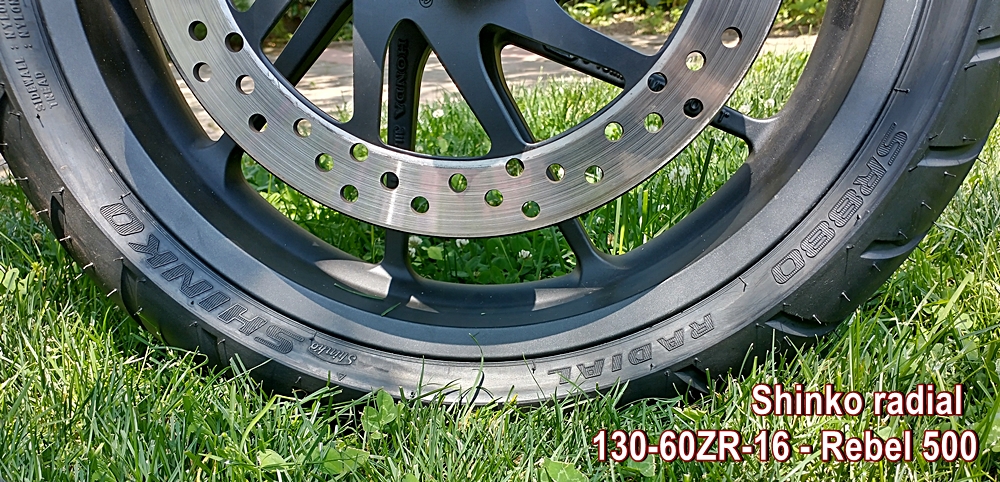
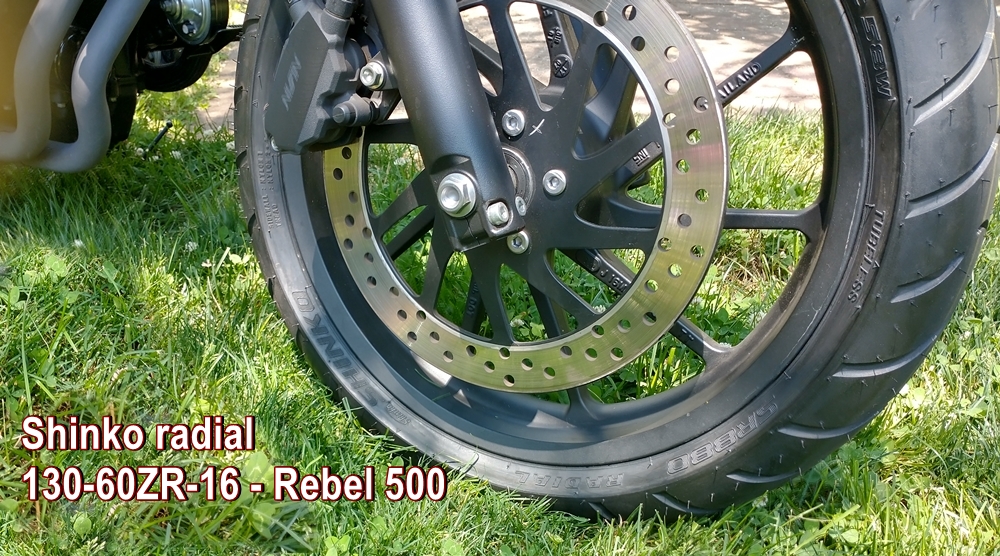
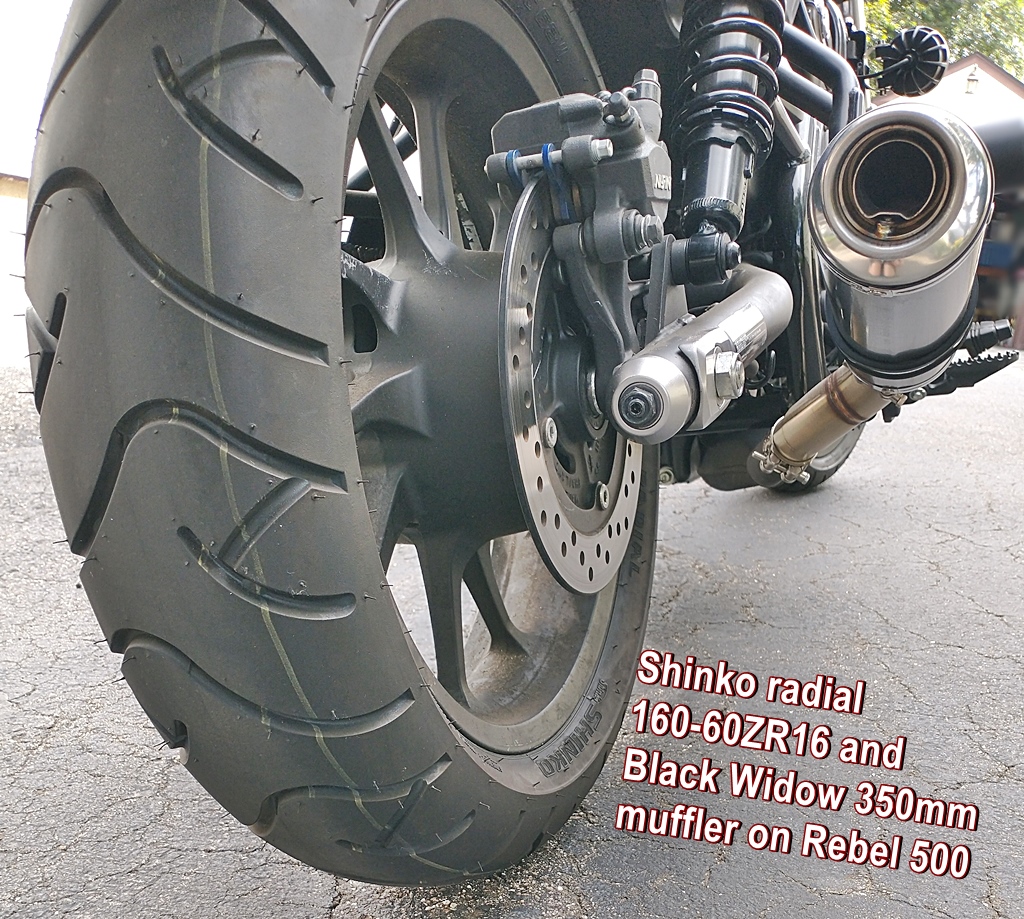
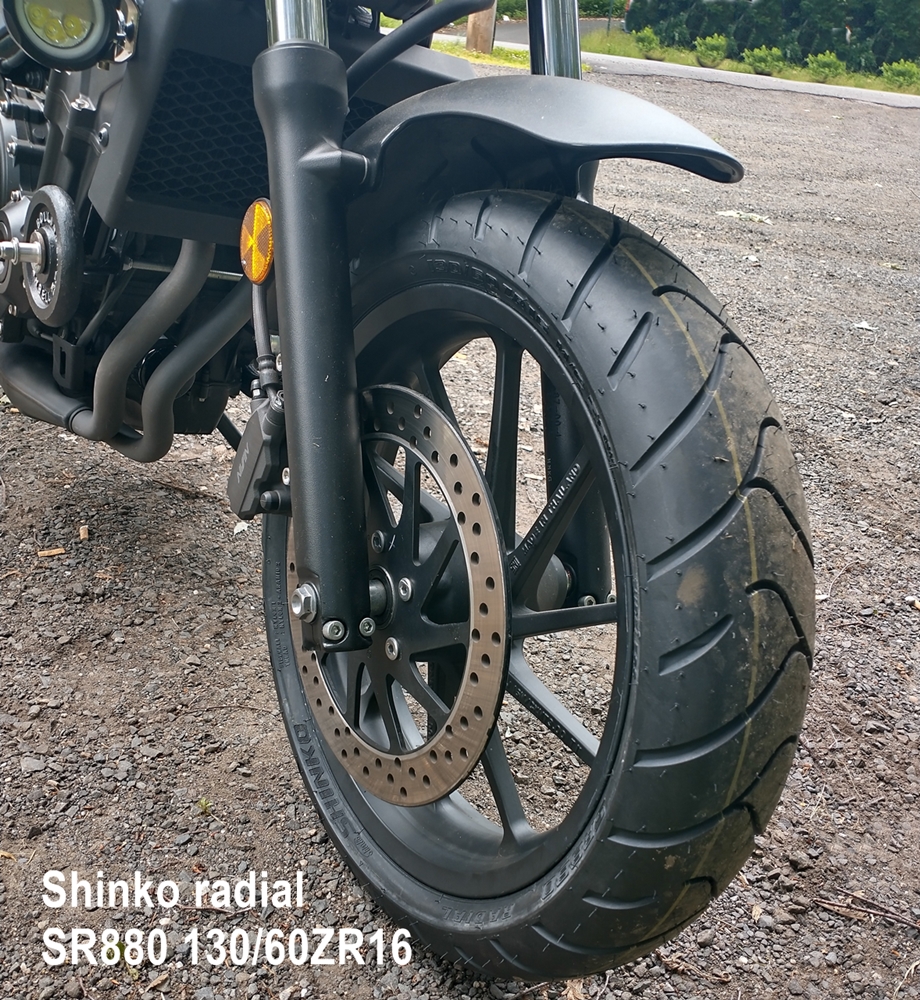
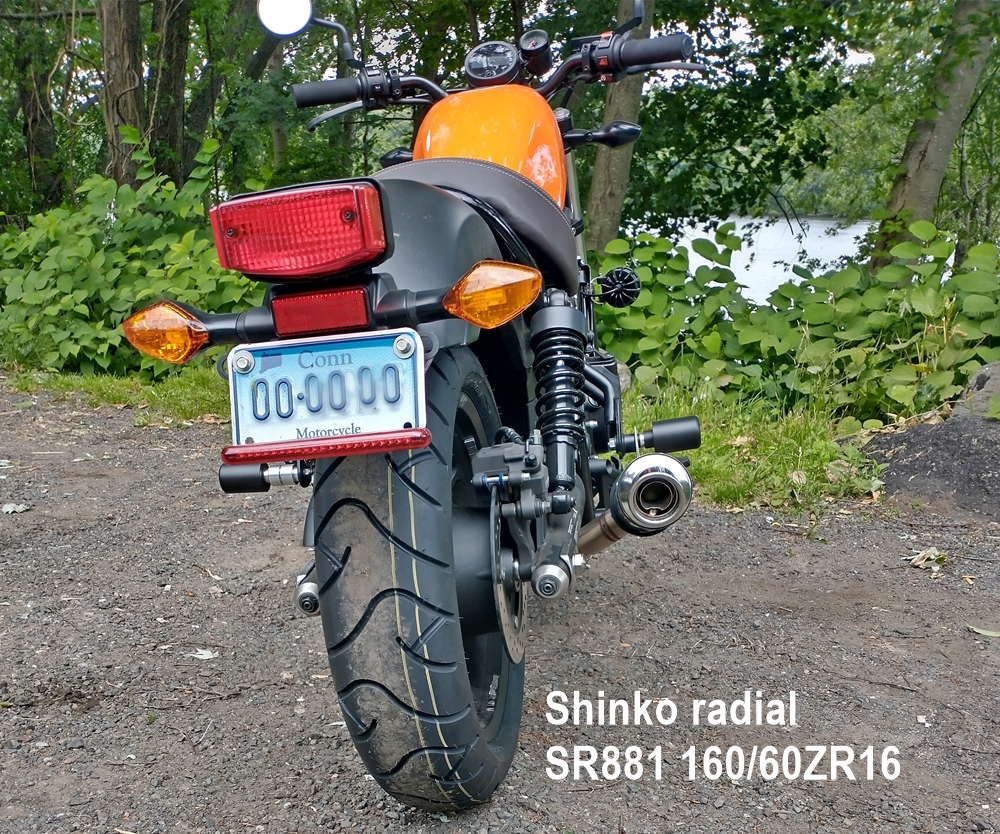
I have Shinko Radial tires for my Rebel 500. The front is the same width but lower profile. The rear is slightly wider (160 series) and a lower profile. A 180 series will fit the Rebel 500 rear so 160 will fit with no issue. This tire is “designed for smaller sport bikes like CBR 250/300, Ninja 300, R3, KTM 390”. I will start off with the front at 29 lbs and the rear at 28 lbs , since it is wider than stock.
Compared to radials, bias ply tires are better for heavy loads (but at moderate speeds). They are required for spoked wheels and off road bikes. Compared to bias ply tires, radials provide more grip in the dry, even more grip in the wet, and absorb bumps better. Radials are lower profile, lighter in weight for improved gas mileage, less rotating mass for quicker steering response and acceleration.
I believe the Shinko SR880/881 is a soft compound tire so unlike most radials it will probably not have a long life. Due to the low profile rear tire, my gear ratio will be higher by 9.5%, increasing my acceleration. With the speedometer 70 mph indicated will be 65 actual. The lighter tire weight will additionally increase my acceleration. The stock 5.9 second 0-60 mph could drop to about 5.5 seconds. Compared to bias ply tires, radials absorb bumps better and have a smoother ride which should make a big improvement with the Rebel 500.
Shinko radial SR880 Front Tire (130/60ZR-16) $130 USD / Shinko radial SR881 Rear Tire (160/60ZR-16) $132 USD
———————————————————–
Simple fork Mod – The front forks on my GT650 are a bit soft. So today I put an extra 10mm of oil in each leg and 3 washers in each leg. Washers are 37mm in diameter and 2.5mm thick. Seems much better now with that extra pre load. See how it goes.
Designed for smaller sport bikes like CBR 250/300, Ninja 300, R3, KTM 390
Shinko Tire is based in Japan, with manufacturing in South Korea
https://www.cbr250.net/threads/shinko-sr-880-881-radial-tires.52626/
———————————————————–
Rebel 500 TIRE WIDTHS – Rebel 500 chain guard clearance is 0.5 inches (12 mm) – Rebel 500 chain clearance 0.75 inch (18mm). Just grinding down the plastic chain guard will give you 1.5 inch (37 mm) without adding any spacers. So the rear tire could safely be 1.25 inch (31 mm) wider (180 series). Rebel 500 front fender clearance 0.5 inches (12 mm) – you could gain 2-3 mm more by grinding down the fender mounting bolts. So the front tire could safely be 1.0 inch (25 mm) wider (160 series).
A 190 series would hit the chain and would require spacers to work.
———————————————————-
It is OK to use radial on back and bias in front, but not bias on back and radial in front.
From Cycle World:
Years ago, back when radial motorcycle tires first hit the market, tire makers strongly advised riders not to mix radial and bias tires. Radials were new and offered significantly different handling characteristics than bias rubber, and neither the bike manufacturers nor the tire companies yet had enough model- and tire-specific data to predict how a combination of the two would affect the handling of any given motorcycle. So the best policy was to discourage mixing radials and bias tires.
Since then, radial technology has evolved dramatically, and the manufacturers have had years to develop a better understanding of the effects of mixing tire types. As a result, numerous production bikes, including two new models tested in this issue – the Harley-Davidson Rocker and the Yamaha Star Raider S – come from the factory equipped with a radial on the rear and a bias-ply tire on the front.
Weight examples: Shinko Podium 150/60VR17 14lb / Pilot Powers 150/60ZR17 13lb
SuperMoto, Dunlop SportMax GPR-300
Universal fit. May require additional adjustment or modification.
A Radial tire specifically designed for small displacement sport bikes. Advanced belt design and Jointless Band (JLB) rear tire construction utilizes a continuously wound belt for smooth performance and a consistent tire contact patch. Aggressive sport-derived treat pattern for enhanced on-bike appearance.
These tires are all tubeless and H-rated (max speed of 130 mph)
——————————————————
(no longer available in 16 inch) Continental ContiMotion – Product Evaluation
Tire “deflation” can be a good thing.
By Cycle World – October 14, 2010
With all the excellent deals to be had on things like used motorcycles during the Economic Downturn, it’s a shame none of that has trickled down into the motorcycle tire marketplace. Or has it? Continental Tire introduced the zero-degree-belted ContiMotion about a year ago, calling it “a contemporary, high-quality radial tire for budget-minded customers.”
Curious, we spooned a pair onto Feature Editor John Burns’ economy-minded Kawasaki ZX-9R naked ratbike and were pleasantly surprised by their performance. While these tires may not provide the outright grip of the Pirelli Corsas they replaced, there’s still plenty of peg-dragging traction, along with confident, predictable steering manners that encouraged us to flog the old Ninja right along in the expendable manner to which it’s grown accustomed.
Furthermore, the Contis provide an outstandingly smooth ride with excellent small-bump absorption (almost feels like somebody serviced the suspension). With the old Ninja’s LSL Superbike handlebar kit, steering remains as light and neutral as ever, along with flawless stability. We can’t speak to mileage, but Conti claims its unique compounding and the wide treadless area in the rear’s center will provide above-average wear.
Here’s the best part: Conti’s suggested price for a 120/70-17 front is $81, with the 180/55-17 rear selling for $123. Online shopping turned up prices even lower. Seems like a reasonable fee to pay for good rubber, especially for an under-appreciated bike that’s not worth a helluva lot more than that. Except to the person who loves it.
 Rebel500